
Let’s say you have some personal financial documents that you need to keep safe. At home, you store them in a fireproof lockable safe. Now you have to send them to your Accountant and you need to ensure that it’s not accessible by anyone except the authorized receiver. So you use a secure mailing service that ensures that the documents are tracked, insured, and requires a signature upon delivery.
Your Accountant signs and receives them, only to tear them open so she can take a quick look while walking through the hallway, exposing the content of the document! That would be very unprofessional right?!🤔
stay with me
Data exists in 3 states, at rest (in data storage, databases, or data centers), in transit (while moving through a network), and in use (while processing). For years, service providers have offered encryption services to help secure data at rest and in transit, leaving the data vulnerable when in use.
Confidential computing ensures that data is also protected when in use, making it secure at every stage of its lifecycle.
This deep-dive explores Arcium - a Parallelized Confidential Computing Network, that aims to enable secure, decentralized, and collaborative data computation across various sectors. In subsequent sections, we'll be exploring Arcium's architecture, features, use cases, and its benefits for on-chain applications.
Let’s dive in.
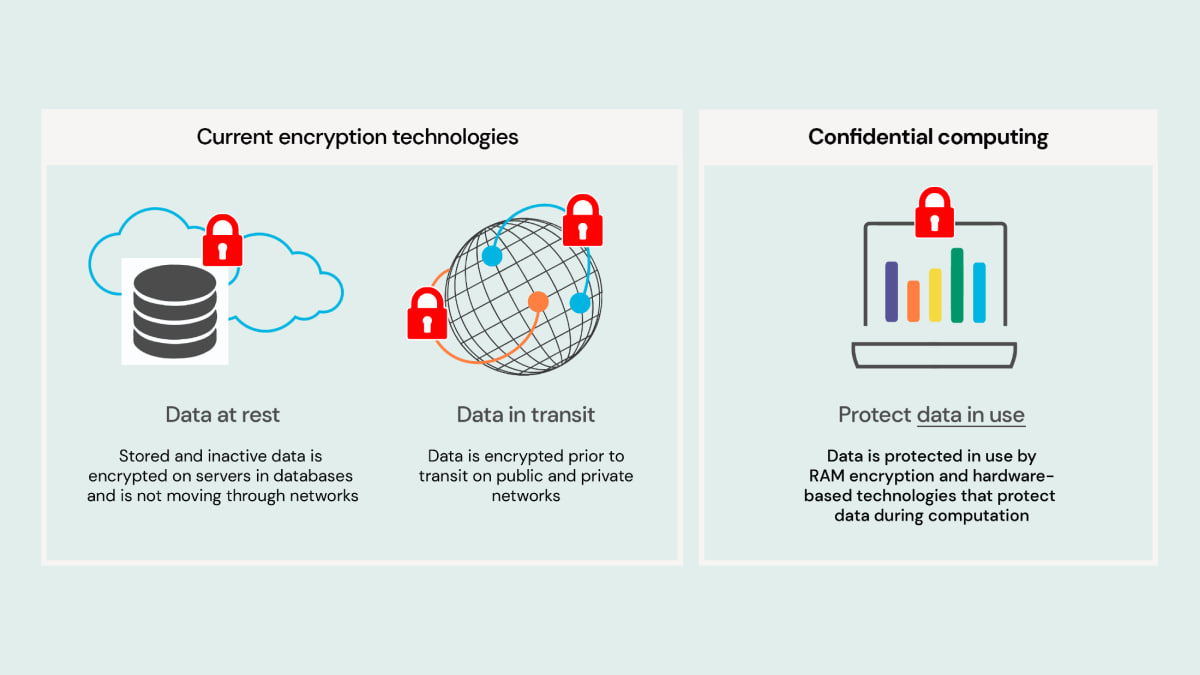
An illustration of confidential computing byledidi.com
Applications process data, and to do this, they interface with a computer’s memory. Before an application can process data, it has to be unencrypted; and because the data is unencrypted for a moment, it is left exposed.
Let’s break it down
Remember our analogy of your Accountant? She had to read the documents she received. And because she had to read them (process), she unsealed them (unencrypt) for a while, making the documents exposed. Again because she was in an open space, anyone could pry on that document right before she read them, while she was reading them, and after she must have read them.
In the context of the data processed in a computer memory, the data is exposed to threats such as memory dump attack, Root user compromise, and other malicious exploits.
- Memory dump attack is an attack that triggers an error log (known as memory dump) in a RAM storage, in other to expose the data in it.
- Root user compromise: occurs when the wrong person gains access to admin privileges and can access data before, during, and after it has been processed (remember the prying eyes?)
Confidential Computing solves this problem by using a secured hardware-based architecture, known as Trusted Execution Environment (TEE).
TEE is a secured area of a processor, embedded with encryption keys and an encryption attestation mechanism that ensures that it cannot be accessed by unauthorized codes [Think of it as an AI-sensor or a fingerprint lock on your safe which can only be accessed by you].
This ensures that sensitive data remains in memory until the authorize application requests it to be decrypted for processing and while the data is being released for processing, it is invisible to the operatiing system or service provider.
This approach to confidential computing ensured that the confidentiality and integrity of data were being protected from its immediate environment but was far from being the perfect solution. How? you may ask…

Arcium is a Parallelized Confidential Computing Network, that provides developers and applications with a trustless, variable, and efficient framework to run encrypted computation.
Okay, let’s break that down
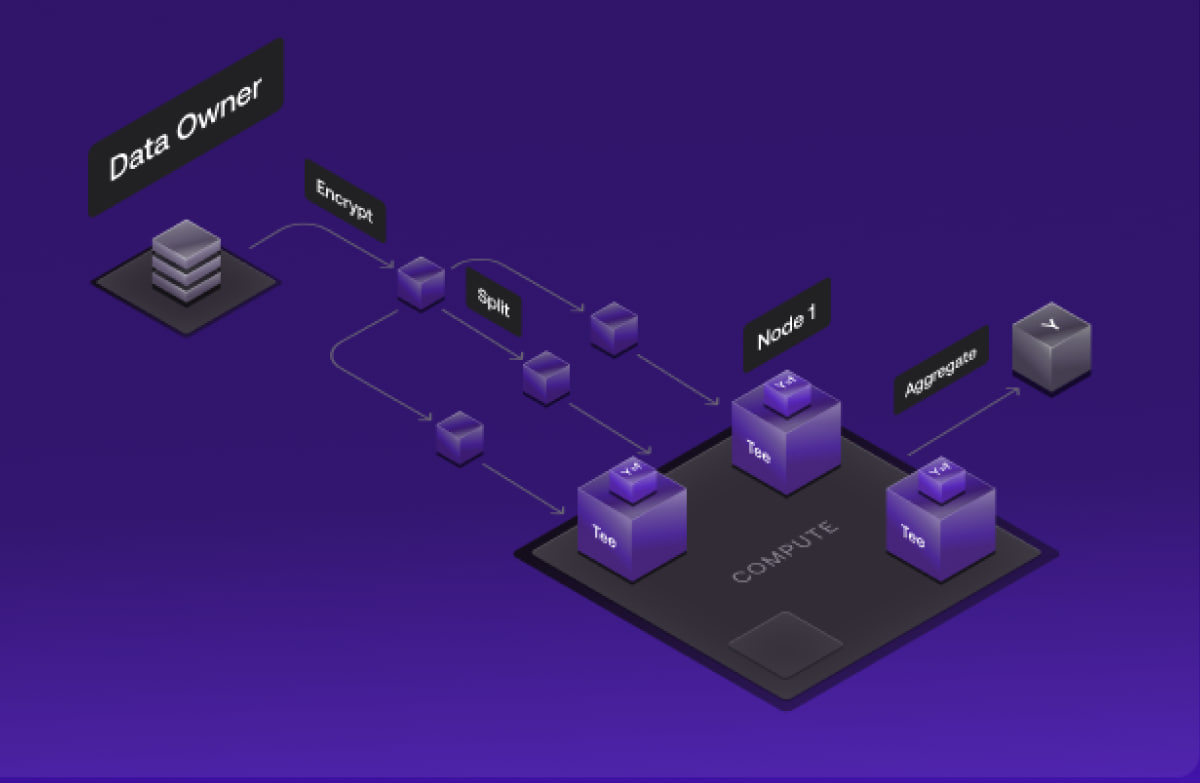
An illustration of Arcium's architecture byArcium.com
Unlike traditional Confidential Computing solutions that rely on centralized hardware-based execution environments, Arcium Network leverages a decentralized architecture and cryptographic-based encryption to enable trustless, variable, and encrypted computation without the need to rely fully on hardware trustless parties.
Remember our Trusted Execution Environment in traditional confidential computing? That was a single centralized solution used to secure processing data from its immediate environment.
In modern architecture, Arcium uses decentralized Nodes (think of it as multiple interconnected TEEs, with more powerful features). Each node is called an Arx node, and is used as an individual computing service provider that contributes to collective computation processes.
Depending on a Network User’s need, the nodes can be grouped into clusters which are then used to execute computations. That is, they can share computation results, allowing the network to derive a cryptographically final output, without any node having access to the complete data from others.
The environment that enables the node cluster to jointly execute these computations is called a Multi-party eXecution Environment (MXE).
Multi-party eXecution Environment defines a set of parameters for secure multi-party computations to be executed on the network.
It allows Network Users (also known as Computation Customers) to define relevant parameters for their computation needs which includes:
Authority: Who is allowed to initiate an execution of a given MXE?
Cluster: What nodes are allowed & mandated to participate in executing this MXE?
Protocol: What MPC protocol is to be used?
IO Scheme: Where does the input data come from and where should the output data be written to?
Computation Definition: What operations are allowed on the data and how are the operations defined?
MXEs can be defined in two ways;
As persistent: Meaning they can be reused indefinitely into the future.
As single User: Which indicates that the MXE may only be used for one computation, and then automatically discarded.
The Arcium Network uses programs running on the Solana Blockchain to manage and Orchestrate all aspects of the network’s state and services such as pending computations and participants' incentives.

With its decentralized and multi-cryptographic architecture, Arcium redefines how sensitive data is processed and shared in a trustless environment. Some of its key features include:
Remember how the TEEs approach in traditional confidential computing used just one central processing environment? That means every computation had to wait in queue to be executed.
Arcium's decentralized approach changes that. With multiple clusters of nodes working together, and with each having the ability to manage its own task, computations are done at the same time, making sure that the system can handle a lot of work right from the start. This means more task can be done at once, increasing speed and efficiency.
Arcium's Multi-party eXecution Environments framework makes confidential computing even more powerful by enabling customization. Giving users the flexibility to specify what kind of data they want, how they want it, where and when they want it etc. This opens a wide range of possibilities for confidential data to be used across various industries.
Arcium is both platform and blockchain independent. It provides flexibility and composability across different ecosystems, allowing even non-blockchain based developers to configure it to their platform needs.

Arcium's decentralized architecture with its MXE composability framework brings unique capabilities to confidential computing, creating numerous possibilities for various industries. Here are some use cases where Arcium can be applied:
Hospitals and research institutions constantly analyze patient data for research while ensuring patient privacy.
Arcium's MXE solution will enable secure processing of sensitive health data, allowing for collaborative research without compromising patient confidentiality.
Multiple organizations (e.g., hospitals and financial institutions) need to train a shared AI model using their proprietary data without revealing it to each other.
Multi-party eXecution Environment (MXE) allows secure, privacy-preserving model training by enabling computations on encrypted data from different sources, ensuring that raw data remains confidential.
In managing and transferring assets across multiple blockchain networks without liquidity fragmentation, Arcium's chain-agnostic approach will allow seamless interoperability between different blockchains, ensuring efficient and secure asset management and transfers.
For DePin, the Arcium Network can be used to manage decentralized energy production and consumption in a smart grid. Its blockchain technology can securely track and manage energy transactions, while MXE ensures that sensitive usage data and grid management computations are protected.
Arcium Network can be used in voting systems to conduct secure and transparent elections. Its Blockchain technology feature will ensure the integrity and transparency of votes, while the MXE will ensures that voter data remains confidential.
The secure and decentralized nature of Arcium allows for the safe sharing and management of intellectual property. Creative industries could utilize these features to protect and securely share intellectual properties.
Arcium can be applied in Real Estate Regulatory Compliance and Auditing, using its blockchain feature provides an immutable record of all transactions and actions, simplifying compliance and auditing processes. While Ensuring that all data processing complies with regulatory requirements, protecting sensitive information from breaches.

Launched in May 2024, Arcium has raised its first funding round of $9 million. Backed by major big names in the web3 ecosystem such as Coinbase, L2 Iterative Ventures, Staking Facilites, Anatoly YakAovenko, co-founder of Solana, Lucas Bruder, co-founder of Jito amongst others
Arcium Network currently opens up exciting opportunities to contribute; by Running a Node, Building and Integrating applications with the Arcium Network, Engaging and Expanding, and Delegating stakes to secure the network while earning rewards.
Arcium represents a groundbreaking advancement in confidential computing, seamlessly integrating blockchain technology with Multi-party eXecution Environments (MXE). This unique combination not only enhances security and privacy but also brings unparalleled flexibility and efficiency to various industries. From AI and DeFi to DePIN and real estate property management, Arcium's chain-agnostic approach and decentralized architecture address critical challenges such as data privacy, interoperability, and scalability.
https://arcium.com/what-is-arcium
https://arcium.com/road-to-mainnet
https://docs.arcium.com/staking/overview
https://www.researchgate.net/publication/372801790_Confidential_Computing
https://www.ibm.com/topics/confidential-computing
https://www.fortinet.com/resources/cyberglossary/confidential-computing
https://ledidi.com/blog/confidential-computing-the-missing-link-in-cloud-data-protection